Recently, a team led by Professor Cao Zhi and Associate Professor Chu Chunli from the College of Environmental Science and Engineering at Nankai University, in collaboration with internationally renowned scholars from the International Institute for Applied Systems Analysis in Austria, Leiden University in the Netherlands, and the University of Oxford in the UK, published a review paper entitled “Closing the global sand circularity gap needs a systems approach” in One Earth, a journal under Cell. This paper systematically elucidates potential solutions, providing important scientific evidence and practical guidance for the sustainable management of global sand and gravel resources.
The problem of sand mining is becoming increasingly serious, and the recycling of sand and gravel resources is now imperative.
As the world’s most mined solid mineral resource, sand and gravel play a vital role in construction, land reclamation, and industrial production. Since 2011, global annual consumption of sand and gravel for concrete has exceeded 20 billion tons, accounting for nearly 50% of total non-metallic mineral resource extraction. With global population growth, economic development, and accelerated urbanization, this figure is expected to continue to rise.
While a global crisis of sand and gravel resource depletion has not yet materialized, its extraction has triggered serious regional problems. From an ecological and social governance perspective, the health of sand miners and the ecosystem are also severely threatened. Environmental degradation, economic development needs, and geopolitical factors interact to create a complex systemic problem. Solving this problem requires a comprehensive governance plan that considers both supply and demand, promoting a closed-loop cycle for sand and gravel resources.
There is a significant gap in the recycling of sand and gravel resources, and future demand will be unbalanced with the supply of recycled materials.
The “sand and gravel resource recycling gap” refers to the difference between the total demand for sand and gravel and the supply of recycled sand and gravel. The research team systematically reconstructed the consumption trends of concrete sand and gravel from 1950 to 2018 at the regional and final product type levels. The study found that the consumption of concrete sand and gravel during this period experienced a “significant acceleration,” with an average annual consumption of approximately 24 billion tons, primarily driven by the construction industry. This significant growth was mainly concentrated in emerging Asian economies, represented by China.
In contrast, consumption in more developed regions such as North America, Europe, developed Asian countries, and Oceania has stabilized. While consumption in the Middle East and Africa has continued to grow, the growth rate has slowed. Meanwhile, the types of aggregates used in concrete have also evolved significantly along with the growth in consumption (Figure 1).
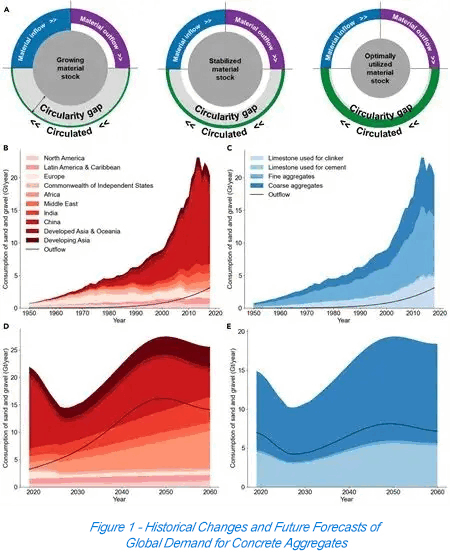
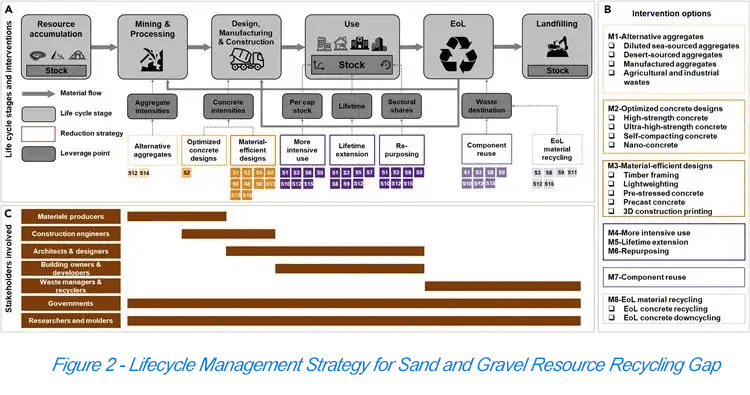
Due to continued growth in global demand, the global removal of concrete aggregate is projected to increase nearly fivefold by 2060. However, even with this increase, the global removal of concrete aggregate will still fall far short of demand, with a shortfall of 11.4 billion tons. This supply-demand gap will persist for decades to come, particularly in low-income regions. Therefore, this review systematically outlines strategies and measures that can be taken to narrow the cyclical gap in aggregate resources at each stage of their life cycle, and focuses on analyzing the key stakeholders and their roles at each stage (Figure 2).
Promote the sustainable use of sand and gravel resources
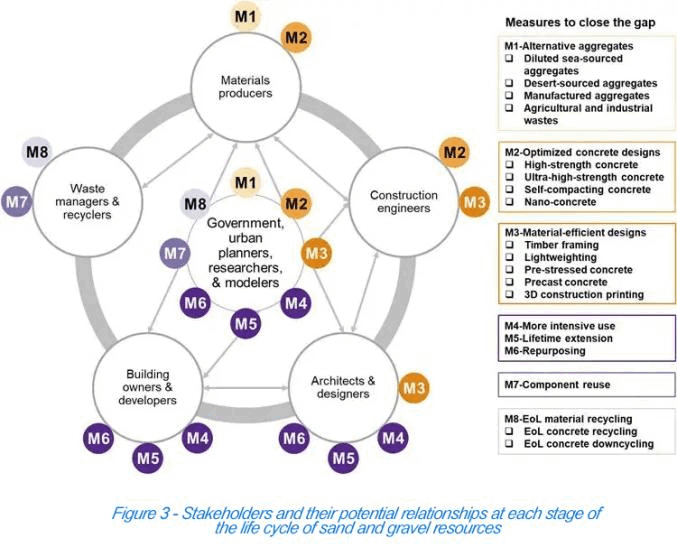
The research team found that relying on a single strategy or measure is insufficient to comprehensively address the enormous challenges of sand and gravel resource recycling. Achieving sustainable management of sand and gravel resources requires a unified, systematic approach involving all stakeholders, including material producers, building engineers and designers, construction companies, and developers. Only by integrating the strengths of all parties and collaboratively promoting sustainable practices can the resource utilization efficiency of the construction sector be effectively improved (Figure 3).
The study calls for global collaboration to promote the sustainable use of sand and gravel resources, providing important scientific evidence and practical guidance for the construction industry, policymakers, environmental researchers, and all sectors of society to bridge the gap in sand and gravel recycling.
The review, titled “Closing the global sand circularity gap needs a systems approach,” was published online in One Earth magazine on February 21, 2025.